Updated on 30th June 2026
The Reserve Bank of Australia (RBA) has finalised reforms to card payment surcharging and interchange fees, effective 1 October 2026. As your payments partner, we're committed to making this transition straightforward for your business. We are currently in the planning and preparation phase, working closely across teams to ensure everything is in place for a smooth transition for our partners and customers.
On 31 March 2026, the RBA released its final Conclusions Paper on Merchant Card Payment Costs and Surcharging.
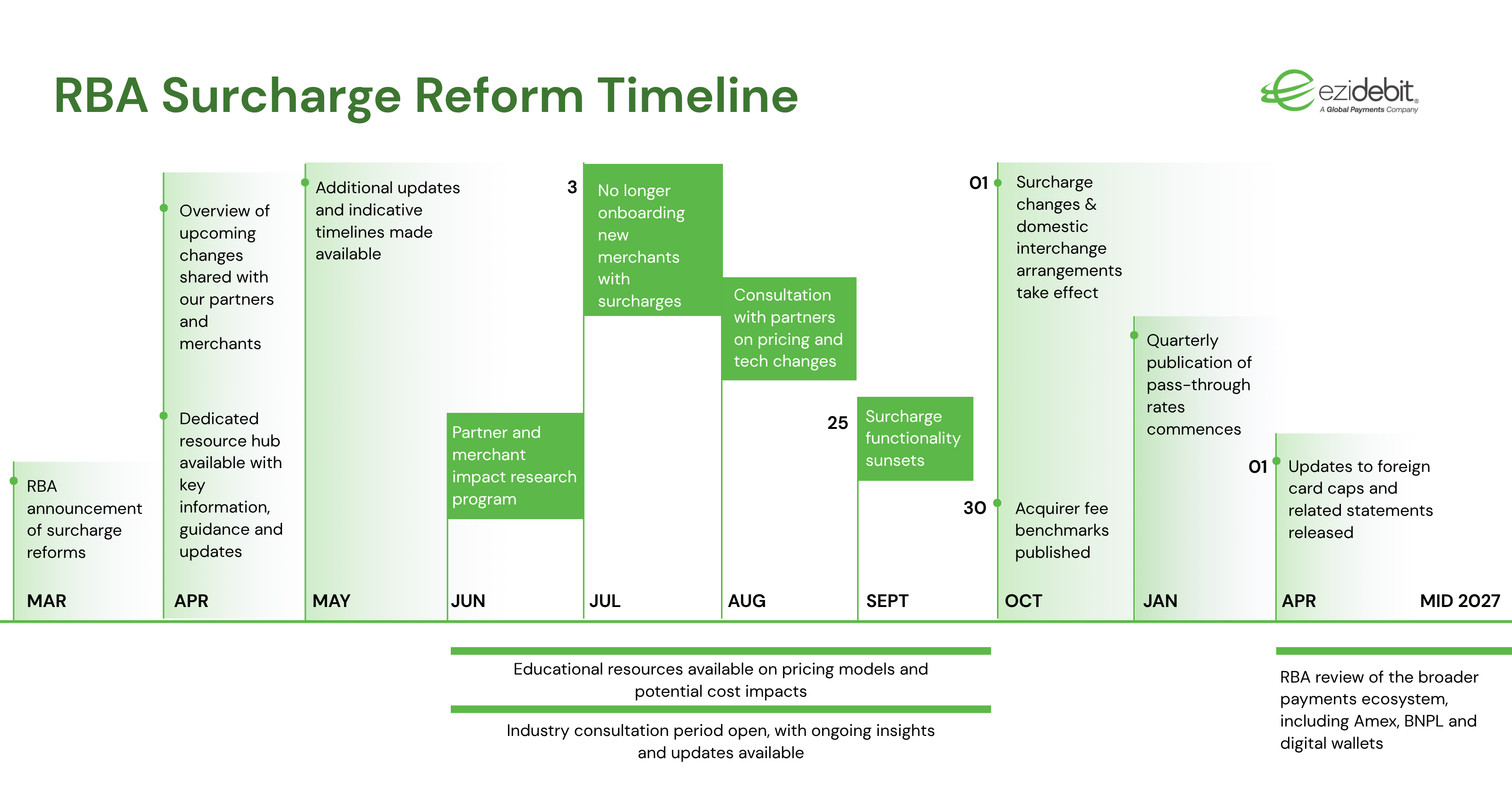
| 1 Oct 2026 | Surcharge ban + domestic interchange cuts |
| 30 Oct 2026 | Acquirer fee benchmarks published publicly |
| Jan 2027 | Pass-through rates published quarterly |
| 1 Apr 2027 | Foreign card cap + enhanced statements |
| Mid-2027 | New RBA review: Amex, BNPL, wallets |
One of the most common questions we're hearing is whether payment fees are disappearing.
The answer is no.
From 1 October 2026, businesses will no longer be permitted to apply a surcharge to Visa, Mastercard, eftpos and American Express (Amex) card payments. However, businesses will generally continue to incur payment processing costs when customers pay by card.
Payment fees aren't disappearing. The key change is that businesses can no longer recover these costs through a seperate card surcharge.
| Today (Before 1 October 2026) | After changes (From 1 October 2026) |
| Businesses can apply a surcharge to card payments | Surcharges on Visa, Mastercard, eftpos and Amex card payments are no longer permitted in Australia from 1 October 2026 |
| Payment processing fees apply when accepting cards | Payment processing fees still apply when accepting cards |
| Customers may see an extra charge at checkout | No separate surcharge can be added at checkout |
| Businesses may use surcharging to offset payment costs | Businesses will need to consider how costs are managed within their overall pricing model |
| Ancillary fees such as dishonour and admin fees can be passed on to customers | There are no changes to these fees under the reform, the reform affects transaction surcharges only |


We are taking a phased approach to ensure we can carefully plan and prepare while supporting merchants and platform partner through each stage of the transition. Here is what you can expect from us:
We are committed to making this transition as seamless as possible for every merchant and platform partner.
To help you prepare, we recommend the following:
“This is one of the most significant changes to Australia's payments landscape in decades, and we're committed to guiding our partners and merchants through it with clarity and confidence, so they are prepared ahead of the deadline. Our focus is to make the transition seamless and work closely with our partners and merchants to make sure they’re not just compliant, but well‑positioned to thrive in a more transparent, lower‑cost payments environment.”
Alison Morris, General Manager, International Integrated and Platforms
No. Businesses will generally continue to incur payment processing costs when customers pay by card. The changes relate to surcharging, not the underlying costs of accepting card payments.
No. These changes apply to card payments and do not affect direct debit payments from bank accounts.
The surcharge changes apply regardless of whether a card payment is one off or recurring.
While the Reserve Bank of Australia's (RBA) reforms apply to Visa, Mastercard and eftpos payments, American Express has separately announced that surcharging on Amex card transactions will also end from 1 October 2026.
You may currently be applying a surcharge if:
You may also find information about your surcharging arrangements or payment fees in your agreement with your payment service provider.
Understanding how much income your business currently receives from surcharging may help you prepare for upcoming changes.
You may be able to find this information by:
If you're unsure where to find this information, please contact our support team.
Every business is different. Businesses should consider their own circumstances when deciding how to manage payment costs following the end of surcharging. You may wish to seek advice from your accountant or business advisor.
No immediate action is required.
However, now is a good time to:
A practical guide explaining what is changing, what isn't, and how businesses can understand whether they may be affected.
A practical checklist to help businesses understand their current position and prepare for the upcoming changes.
Explore some of the approaches businesses may consider after surcharging ends, including absorbing costs, reviewing pricing and improving price transparency.
We invite you to share your perspective as part of our RBA surcharge reform research program. Your feedback will shape how we approach pricing, support and communication to you through these changes.
Register your interest here